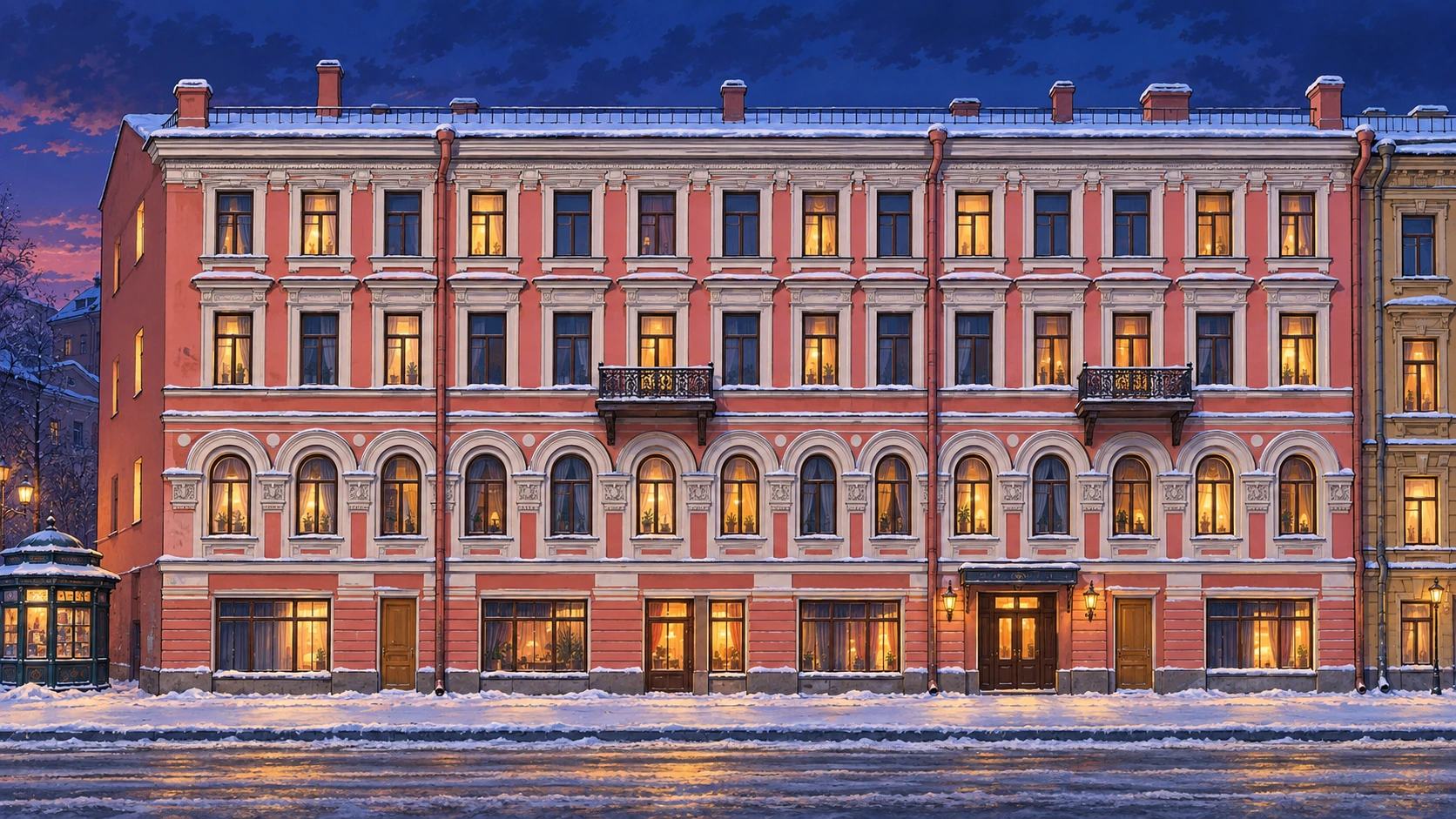
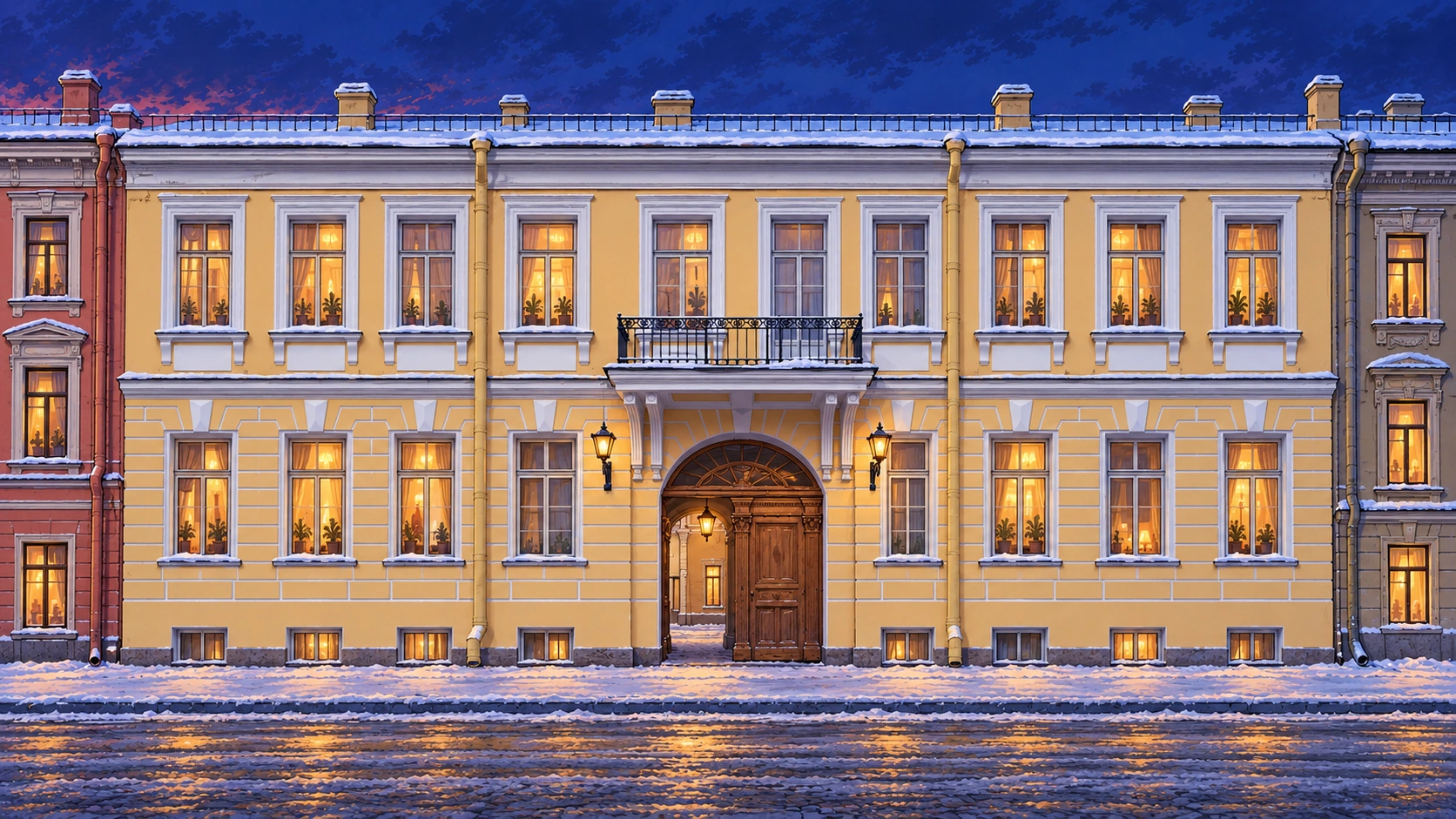
Winter on a St. Petersburg rooftop. Pedestrians pass below while icicles hang above them. Choose when to strike: the ice must shatter on the pavement without hitting anyone. The two painted facades belong to real addresses — 13 Rubinstein Street and 12 Moika Embankment.
Turn on sound for the music and the pedestrians’ reactions. Their recorded lines stay in Russian when the interface switches to English.
Move along the roof. Strike when the pavement below is clear. The first shift on Rubinstein Street begins with five pedestrians. Later, crowds grow and people change pace or direction. Time falls to: 50, 45, 40, 35 and 30 seconds. Win all five on Rubinstein Street to unlock five more on the Moika.
On a computer, use the arrow keys to move, Space to strike and Escape to pause. On a phone, rotate to landscape. Hold a finger down and drag to steer; a short tap strikes, even if another finger is already steering. Progress and sound stay in this browser. The game also offers an Add to Home Screen button. A supported Android browser may show a system install prompt; on iPhone, the button explains the Share → Add to Home Screen steps. Launching from the icon removes the address bar. The game does not promise complete offline access.
Two game locations
See the facade. Then look behind the windows.
The illustrations are inspired by these real addresses, but they are not exact copies of the buildings or records of how they looked in any particular year.
13 Rubinstein Street · an illustrated scene inspired by the address.
01 · 13 Rubinstein Street
The Ruadze house and its music
Architect Nikolai Grebyonka built this apartment house for Maria Ruadze in 1863–64, when the street was still called Troitskaya. Its four storeys, decorated rows of windows and cast-iron balconies belong to the eclectic style of nineteenth-century Petersburg. Large apartments and modern comforts served well-off tenants. A concert hall stood behind the street facade, in the courtyard. After the property changed hands, the hall became known as Pavlova Hall; people gathered here for performances long before electric guitars arrived. The local history project Na Rubinshteina documents the building (in Russian).
The Leningrad Rock Club opened at this address in 1981. An officially permitted venue gave musicians room to perform and meet when much of the scene had previously lived in private flats and informal concerts. Its first show on 7 March included Piknik, Mify, Zerkalo and Rossiyane; Kino, Aquarium and Alisa became associated with the club later. ITMO University’s English guide places the club here and notes that it is no longer active; the local club history records the opening concert. By the game’s imagined winter of 1996, the old club had ceased to operate in its familiar form. A children’s musical theatre has occupied the building since 1995.
12 Moika Embankment · an illustrated scene inspired by the address.
02 · 12 Moika Embankment
Pushkin’s last apartment
The second facade leads to the former Volkonsky mansion. In September 1836, Alexander Pushkin rented a ground-floor apartment here and moved in with his family. He described it to his father as the house of Princess Volkonskaya on the Moika, near Konyushenny Bridge. The now familiar street number, 12, was assigned only in 1880. That small change in the address is a reminder that a family home, a city map and a memorial site can all describe the same building in different ways. The museum’s Russian history records the address.
Pushkin spent the last months of his life in the apartment. He died there in February 1837 after being mortally wounded in a duel. Today it is the Pushkin Apartment Museum, part of St. Petersburg’s National Pushkin Museum. The rooms have been reconstructed from documents and recollections; the museum distinguishes original belongings from objects that help evoke the period. Its English page about this exact apartment explains what visitors can see. The game’s History button offers a shorter note while you play; here you can follow the address back to the museum itself.
The street’s soundtrack
Lines people recognise
The game uses sounds from memes popular in Russia. For many Russian millennials, memes are social glue: a familiar line can bring people in on the same joke. Plenty of memes contain profanity or insults, but we chose the most polite clips we could. St. Petersburg is Russia’s cultural capital, after all.
For example, when an icicle falls near a woman or hits her, she reacts sharply and mentions ZhKKh, asking what they are doing. ZhKKh stands for zhilishchno-kommunalnoye khozyaystvo — housing and communal services, which include building maintenance and clearing ice.
The title
Why “Sosuli”?
Sosuli is the plural of sosulya, a Russian word for icicle; many speakers are more used to sosulki. In 2010, St. Petersburg governor Valentina Matviyenko used sosuli while discussing roof ice and suggested cutting it with lasers or steam. The unusual-sounding word beside a futuristic answer to a municipal chore made the remark memorable. Russian newspaper Fontanka recounts the 2010 meeting; an AFP report in English later describes the viral laser video. Matviyenko did not invent the word: Gramota’s Russian dictionary lists it.
The game’s winter of 1996 is an atmosphere. The sosuli reference belongs to 2010, and some voice memes may be newer still. These are deliberately mixed cultural moments, not a reconstruction of one date. Falling ice can kill people, as the AFP account makes painfully clear. The joke is about language and municipal absurdity; the game asks you to protect the people below. A hit ends the shift immediately.
Back to the roof
You know the addresses. Now pick your moment.
Open the game, try the first shift and watch how the street changes as the pavement grows busier.